Frequently Asked Questions
The most-asked questions about belgian cuisine.
What is Belgian cuisine actually known for beyond the stereotypes?
Belgian cooking is a rich fusion of French technique, Germanic heartiness, and a deep regional identity, producing dishes like waterzooi, carbonnade flamande, and stoofvlees alongside its more famous exports. It is less about a single signature plate and more about a culture of layered flavors, communal eating, and pairing food with craft beer.
What is the difference between Brussels waffles and Liège waffles?
Brussels waffles (gaufres de Bruxelles) are large, rectangular, and leavened with yeast, giving them a light, crispy shell meant for toppings. Liège waffles (gaufres de Liège) are smaller, rounder, and made with a batter containing pearl sugar that caramelizes during baking, yielding a chewy, naturally sweet result.
Why are frites (french fries) considered a Belgian cultural institution?
Belgians claim the invention of fried potatoes in the 17th century, and frites are treated as a standalone meal rather than a side dish. Dedicated 'frituur' stands dot every town, and the quality of the cut, double-frying method, and accompanying sauces (from mayonnaise to andalouse) is taken very seriously.
What makes Belgian chocolate distinct from other European chocolate?
Belgian chocolatiers pioneered the 'couverture' technique of blending high-cocoa butter with cocoa solids and sugar, creating a smooth, melt-in-the-mouth texture. The country's small-batch artisan tradition, exemplified by houses like Neuhaus, Godiva, and Leonidas, emphasizes pure Belgian couverture over compound chocolate.
How important is beer to Belgian food culture?
Beer in Belgium is as central as wine is in France, with over 1,500 active varieties ranging from wheat-based witbiers to dark tripels and fruit lambics. Dishes are often designed to complement specific beer styles, and a 'biertje' is the default accompaniment to nearly every meal.
What is moules-frites and why is it considered a national dish?
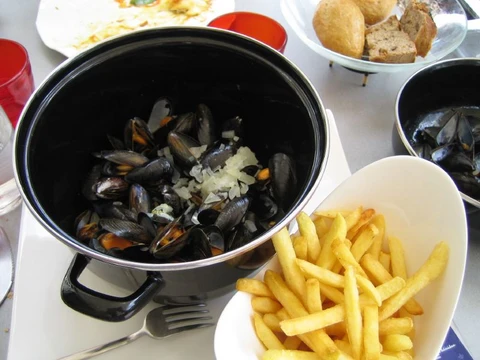
Moules-frites is mussels steamed in a broth of white wine, garlic, and herbs, served with a generous portion of frites. It is deeply tied to Belgian identity, especially in winter, and is typically eaten with fingers and a communal pot, making it a symbol of casual, communal dining.
What are the main regional differences in Belgian cooking?
Flemish (Dutch-speaking) cuisine tends toward richer, breaded, and stew-based dishes like carbonnade and waterzooi, while Walloon (French-speaking) cooking leans into lighter preparations, game, and mushroom-based plates. Brussels sits in the middle, blending both traditions and adding its own multicultural influences.
What is carbonnade flamande and how is it different from French onion soup?
Carbonnade flamande is a slow-braised beef stew cooked in dark Belgian beer, caramelized onions, and sometimes a touch of rum, served with bread for soaking up the sauce. Unlike French onion soup, it is a hearty meat-and-sauce dish rather than a broth-based bowl, and the beer is the defining flavor agent.
Where should a newcomer start to understand Belgian food culture?
Begin with a simple plate of moules-frites at a local brasserie, pair it with a local saison, and finish with a piece of artisan praline. That single meal touches the three pillars—stew, beer, and chocolate—and gives a compact introduction to how Belgians think about food.
Are there any widely overlooked Belgian dishes worth knowing about?
Stoofvlees (a slow-cooked beef or pork stew), waterzooi (a creamy fish or chicken and vegetable stew), and 'frikandel' (a spiced pork sausage) are everyday staples that rarely appear in foreign food writing. Also, the tradition of 'poffertjes'-style small pancakes and the seasonal dish 'kool met worst' (cabbage with sausage) are deeply embedded in home cooking.