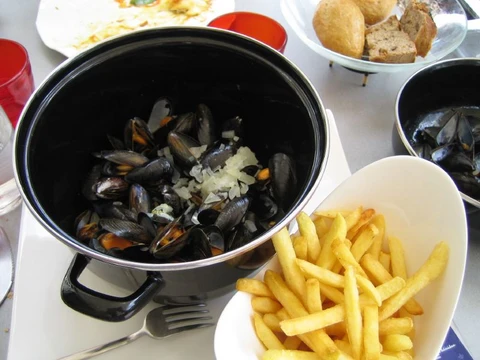
Belgian cuisine
Belgian cuisine blends French refinement with hearty Flemish fare.

Thomas Quine · CC BY 2.0
Belgian cuisine is a regional and seasonal culinary tradition that blends French refinement with heartier Flemish fare. It is best known internationally for its chocolate, waffles, fries, and beer, and features distinctive local dishes such as waterzooi from Ghent, couque biscuits from Dinant, and tarte au riz from Verviers.
- field
- Cuisine
- nationality
- Belgian
- known_for
- Chocolate, waffles, fries, beer, waterzooi, couque biscuits, tarte au riz
- key_ingredients
- Potatoes, leeks, grey shrimp, white asparagus, Belgian endive, horse meat, local beer
- historical_periods
- Prehistory, Gallo-Roman, Middle Ages, Early Modern, Late Modern and Contemporary
Lore & Background
Little is known about early Belgian cuisine, but ancient Belgians likely kept sheep and cattle, grew root vegetables, hunted wild boar, fished, foraged, and brewed beer without hops. Around 2000 BC, migrants introduced primitive wheat, barley, and legumes; goats, sheep, and pigs were raised. The Celtic Belgae, settling around 300 BC, brought poultry, mead, and hops beer. After Roman conquest in 54 BC, trade introduced olive oil, wine, new vegetables, and fruits; salted ham and pork from Belgica supplied the empire. Archaeological finds near Tienen show cereals, legumes, fruits, nuts, olive oil, porridge, bread, salt, and fennel were common, with meat rare for most.
Reader's Guide
Belgian cuisine matters as a distinct European tradition that reflects the country's complex history and regional diversity. Its significance lies in its synthesis of French culinary techniques with hearty Flemish ingredients, creating dishes that are both refined and rustic. The cuisine's emphasis on regional and seasonal products—such as potatoes, leeks, grey shrimp, white asparagus, and Belgian endive—highlights a longstanding connection to local agriculture. Belgium's international fame for chocolate, waffles, fries, and beer underscores its global culinary impact, while local specialties like waterzooi, couque biscuits, and tarte au riz preserve regional identities. The historical evolution from prehistoric foraging and Roman trade to medieval monastic brewing and modern supermarket availability illustrates how external influences and internal innovations shaped a cuisine that remains both traditional and adaptive. Belgian cuisine's legacy is its ability to maintain distinct local dishes while embracing broader European and global food trends.
Did You Know?
- The technique for growing blanched Belgian endive is widely attributed to farmer Jan Lammers at the Hof ter Laken in Schaerbeek in the 1830s or 1850s.
- Belgian cuisine traditionally prizes regional and seasonal ingredients, including horse meat and local beer.
- The first cookbooks in the region date to the Burgundian Netherlands of the 15th century, though attributing them specifically to modern Belgium is anachronistic.
- The ancient Belgians brewed beer without hops, a later discovery.
A Mosaic of Neighbours and Regions
Belgian cuisine sits at a crossroads, absorbing flavours from France, Germany, and the Netherlands while forging its own identity. The result is a table where refined French technique meets the robust, hearty traditions of Flanders. Yet this national character is layered over a patchwork of local specialities: waterzooi belongs to Ghent, the couque biscuit to Dinant, and tarte au riz to Verviers. What makes the Belgian culinary landscape distinctive is that these regional dishes, while rooted in specific towns, are enjoyed across the entire country. At the same time, the everyday diet overlaps heavily with what is eaten in neighbouring nations—hamburgers and spaghetti bolognese sit comfortably on Belgian menus. Because of this, the term "Belgian cuisine" in a meaningful sense points to dishes of genuine Belgian origin or those widely regarded as emblematic of the country, rather than to the full breadth of what its people actually eat day to day.
From Celtic Fields to Roman Kitchens
The culinary roots of Belgium stretch back to the Neolithic transition around 2000 BC, when migrants following the Danube and Rhine rivers introduced small plots of emmer, einkorn, barley, and legumes. The Celtic Belgae, arriving roughly 300 BC, brought the wheeled plough, three-field rotation, poultry, mead, and—crucially—hops for brewing. Then Caesar's conquest in 54 BC wove the region into a four-century Roman framework. The empire's road networks and active trade funnelled Mediterranean olive oil and wine into Gallia Belgica, while the needs of the Roman army drove large-scale deforestation for wheat, barley, and spelt cultivation. New vegetables—cabbage, carrots, onions, beets—and fruits like peaches and plums were introduced, though they only became common by the second century. Some regions specialised in salted ham and pork, supplying cities across the empire. Archaeological digs near Tienen confirm a diet centred on puls, heated cereals with olive oil served alongside lentils, bread sweetened with honey, and freshwater fish, with wine and beer as everyday drinks.
Monasteries, Fasting, and the Rise of Flanders
After Rome fell, Frankish and Germanic settlers reshaped the kitchen: butter replaced olive oil, ale supplanted wine, and some older traditions like fish sauce faded. The baptism of Clovis I's people in the late fifth century placed the Catholic Church at the centre of culinary life. Monasteries became the likely birthplace of Belgian brewing and cheese-making, while the Church's mandate of at least 195 fasting days per year pushed the diet toward bread, fish, and eggs during the tenth and eleventh centuries. As the County of Flanders and the Duchy of Brabant grew into among Europe's most economically advanced regions, Flemish farmers abandoned the three-field system in favour of fertilised land that yielded two harvests a year and supported larger herds. Bruges, Antwerp, and Ghent rose to become Europe's greatest trading hubs, importing Indian spices and exotic fruits. By the thirteenth to fifteenth centuries, dining became a matter of presentation as much as sustenance—dishes were expected to please the eye, garnished with greens and crumbled eggs before reaching the table.
The Seasonal Pantry and the World's Postcard
Belgian cooking has always privileged what the land offers in a given season, and that philosophy still shapes the national pantry. Potatoes, leeks, grey shrimp, white asparagus, Belgian endive, and horse meat form a recognisable core, complemented by local beer and the broader European staples of meat, cheese, and butter. This seasonal, regional approach stands in contrast to the global image Belgium projects abroad, where chocolate, waffles, fries, and beer dominate the conversation. Yet the everyday reality is more nuanced: the same ingredients appear in neighbouring French, German, and Dutch kitchens, and internationally ubiquitous dishes like hamburgers and spaghetti bolognese are just as common on a Belgian plate. The true signature of the cuisine lies not in any single superstar food but in the way regional producers and seasonal rhythms—endive in winter, asparagus in spring, grey shrimp in coastal dishes—combine with the French-Flemish blend to create a table that feels simultaneously local and part of a wider European conversation.
Gallery


Frequently Asked Questions
What is Belgian cuisine?
Belgian cuisine is a regional and seasonal culinary tradition from Belgium that merges the elegance of French cooking with the robust, comfort-food style of Flemish cooking. Its roots stretch from prehistory and the Gallo-Roman era through the Middle Ages into the modern day.
What is Belgian cuisine most famous for?
Internationally, it is recognized for its chocolate, waffles, fries, and beer. On a regional level, signature dishes include waterzooi from Ghent, couque biscuits from Dinant, and tarte au riz from Verviers.
What key ingredients define Belgian cuisine?
The foundation rests on potatoes, leeks, grey shrimp, white asparagus, Belgian endive, and even horse meat. Local beer also plays a central role both in cooking and in pairing with meals.
How does Belgian cuisine's story begin?
Its culinary lineage traces back to prehistoric and Gallo-Roman communities, then evolved through the Middle Ages and the Early Modern period before reaching its contemporary form. That long timeline is what allowed French and Flemish influences to layer over centuries.
Why is Belgian cuisine important?
It represents a distinctive fusion where French refinement meets hearty Flemish tradition, producing dishes and products that have become globally recognized. Its seasonal, region-specific approach shows how local ingredients like endive and grey shrimp can anchor an entire national food identity.
More in Belgian cuisine 1-24
Spotted an error? Know more?
This is a living reference — every entry is fact-audited, and reader corrections feed straight into our audit queue. Suggest an edit · See this site's audit record