Boulets à la Liégeoise
Belgian meatball dish with Liège syrup sauce.

Marianne Casamance · CC BY-SA 3.0
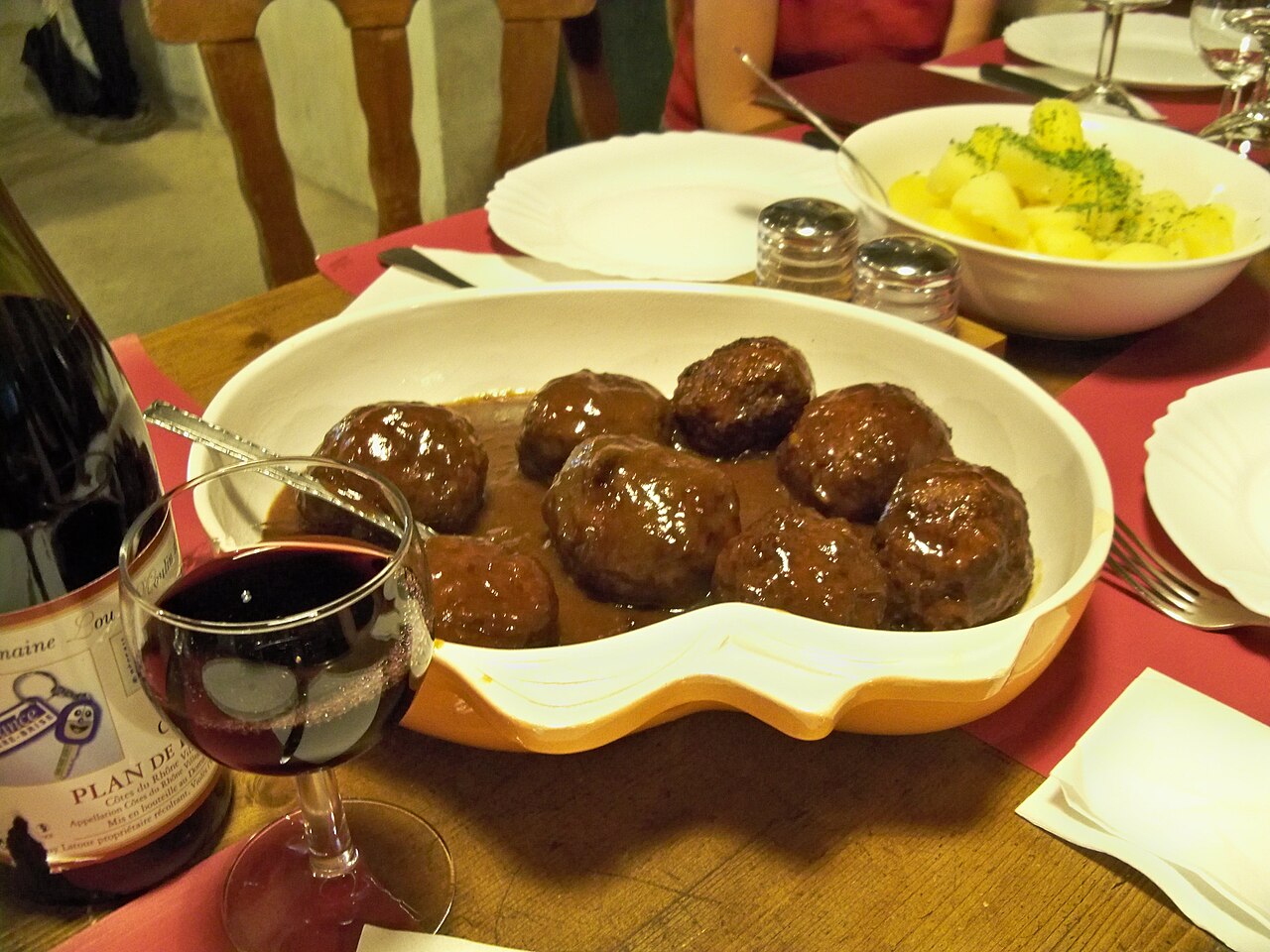
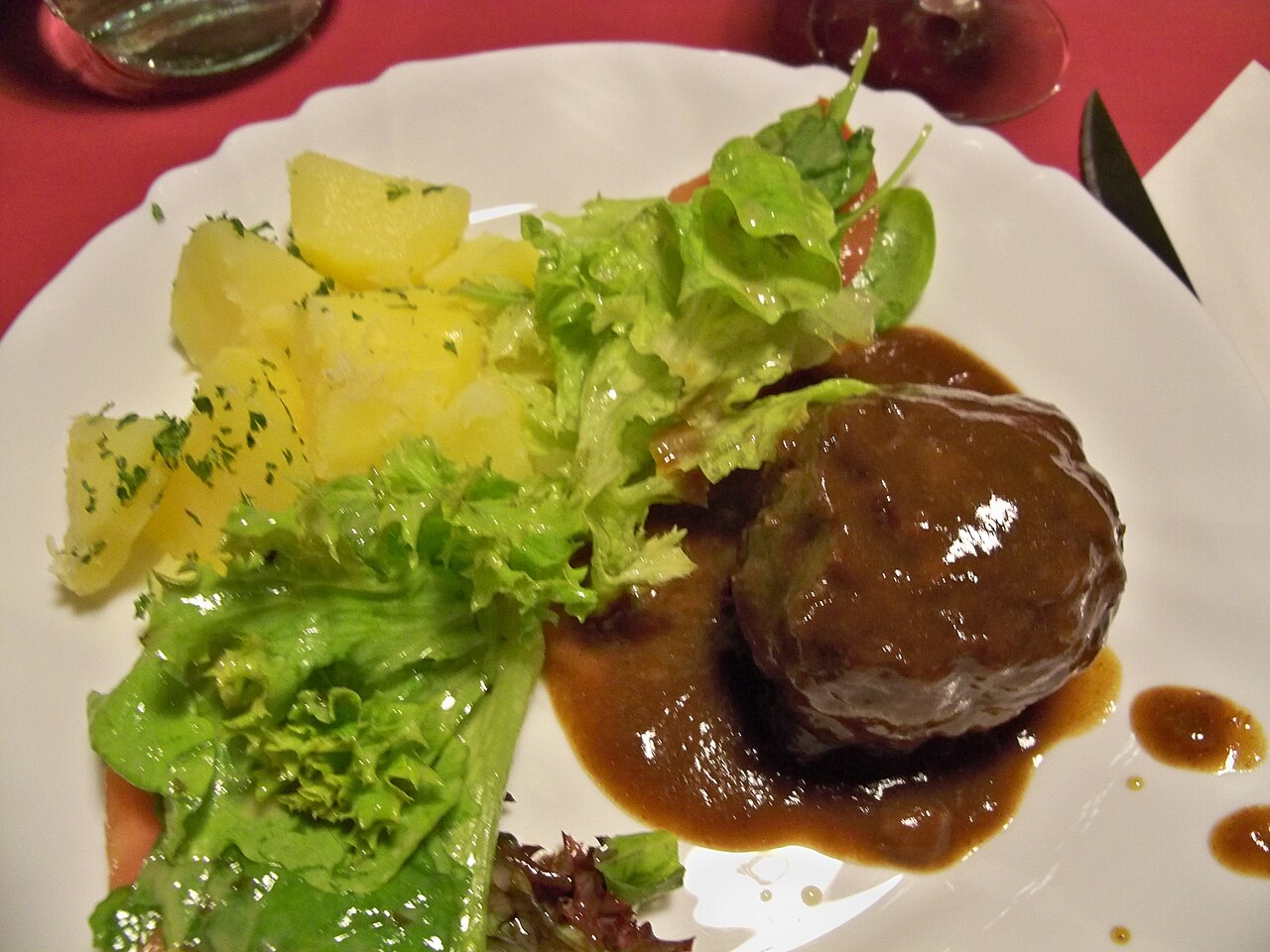
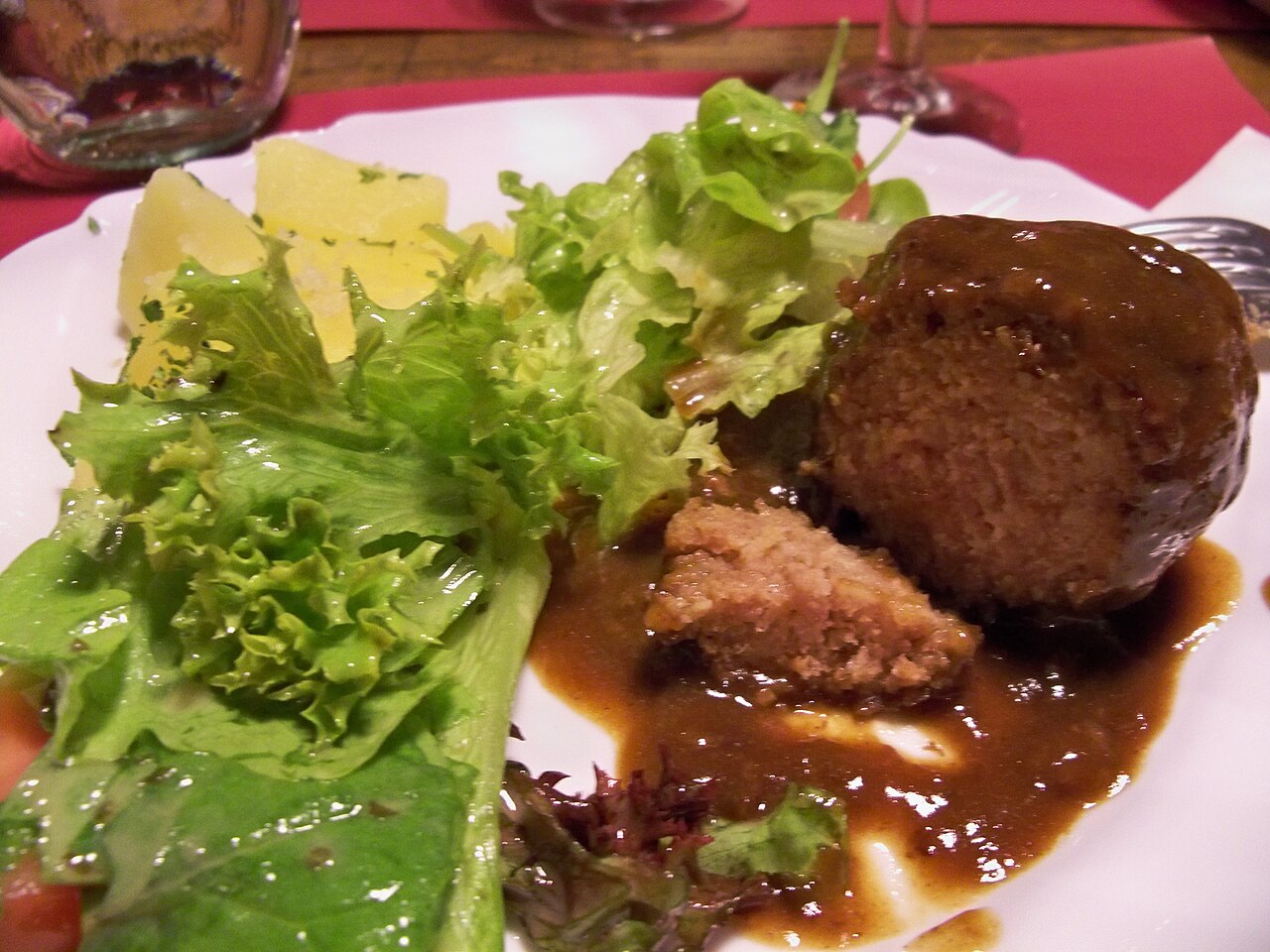
Boulet à la liégeoise is a Belgian dish originating from the city of Liège in Wallonia, consisting of large meatballs made from mixed minced pork and beef or veal, cooked in a sauce containing Liège syrup. It is a regional specialty served in brasseries and friteries throughout Liège and known nationwide, often accompanied by French fries, mayonnaise, and crudités or apple sauce.
- field
- Cuisine
- nationality
- Belgian (Walloon)
- known_for
- Large meatballs in a sweet-sour sauce with Liège syrup
- origin
- Liège, Wallonia, Belgium
Lore & Background
The dish is traditionally made from minced pork and veal or pork and beef, mixed with bread crumbs, onions, and parsley, formed into one or two large meatballs. These are browned in a pan, then simmered in a sauce of onions, vinegar, brown sugar, Liège syrup, and Corinthian raisins. The sauce is called 'sauce lapin' not because of rabbit, but after Madame Géraldine Lapin, born Corthouts, wife of tax collector Ernest Lapin (1868–1922).
Reader's Guide
Boulet à la liégeoise is a cornerstone of Liège's culinary identity, served in most local brasseries and friteries as almost their only specialty. Since 1996, the Gay Boulet Brotherhood has awarded a Diamond Boulet to restaurateurs whose recipe is closest to local tradition, with winners listed annually from 1997 to 2017. The dish is also produced industrially by one company. Its significance lies in its deep regional roots and the community-driven effort to preserve its traditional preparation, as reflected in the brotherhood's awards. The dish's nationwide recognition underscores its role as a symbol of Walloon gastronomy.
Did You Know?
- The sauce is called 'sauce lapin' after Madame Géraldine Lapin, not because it contains rabbit.
- The Gay Boulet Brotherhood has awarded a Diamond Boulet since 1997.
- The dish is traditionally served with French fries, mayonnaise, and crudités or apple sauce.
- One company makes boulet à la liégeoise industrially.
The Meatball and Its Sweet-Sour Sauce
At its core, the boulet à la liégeoise is a hearty Belgian preparation that traces its roots to the city of Liège in the Walloon region. The dish centers on one or two generously sized meatballs—large enough to earn the name "boulet" rather than the diminutive "boulette"—formed from a blend of minced pork and either beef or veal, bound together with bread crumbs, chopped onions, and fresh parsley. The cook first sears these substantial balls in a pan until their exterior achieves a deep golden color, then reduces the heat and allows them to braise slowly in a rich, tangy sauce. That sauce is built from a combination of softened onions, vinegar, brown sugar, the distinctive Liège syrup, and plump Corinthian raisins, creating a sweet-and-sour profile that sets the dish apart from other European meatball preparations. Depending on the neighborhood or the cook's personal tradition, the same plate might be referred to as boulet sauce lapin, boulet chasseur, or simply Boulets, reflecting the informal, home-style character of the recipe.
The Curious Story Behind 'Sauce Lapin'
The sauce that coats the boulet carries a name that has long confused diners and food writers alike. Known locally as sauce lapin—a phrase that translates literally as "rabbit sauce"—it contains absolutely no rabbit. The true origin of the name is a personal one, tied to a specific individual in Liège's history. The sauce is named in honor of Madame Géraldine Lapin, whose maiden name was Corthouts. She was the wife of Ernest Lapin, a man who lived from 1868 to 1922 and worked as a tax collector in the suburbs surrounding Liège. Rather than referencing an ingredient or a cooking technique, the label "lapin" is therefore a tribute to a family name, preserving the memory of a local household in the culinary vocabulary of the city. This kind of eponymous naming—where a dish or preparation takes its identity from a person rather than a component—gives the sauce a layer of biographical meaning that most regional recipes do not possess, and it underscores how deeply intertwined the boulet à la liégeoise is with the everyday lives of Liège's residents.
The Gay Boulet Brotherhood and the Diamond Boulet
Since March 23, 1996, a self-styled organization called the Gay Boulet Brotherhood has taken it upon itself to judge and celebrate the finest preparations of the dish. Each year, the Brotherhood bestows a Diamond Boulet upon the restaurateur whose version most faithfully honors the local tradition. The list of recipients reveals a tight-knit community of Liège-area eateries: Le Bouche à Oreille in Boncelles claimed the honor in both 1997 and 2000, while Café Lequet (Chez Stockis) in the city center took it in consecutive years, 2003 and 2004. The restaurant Le Dernier Ragot on the Clarisses street repeated its success in 2005 and 2006, and the brasserie Au Point de vue on place Verte was recognized in 2008 and again in 2015. Not every year produced a winner—2001 saw no award given—and in 2010 the Brotherhood split the honor between the friterie Chez Adam in Visé and L'Amirauté in Tilff. The award has also traveled beyond the city proper, with recipients in Rotheux, Ans, Visé, Tilff, Nandrin, Chaudfontaine, and Grivegnée, reflecting the dish's reach across the broader Liège region.
A Liège Institution on the Plate
Within the dining landscape of Liège, the boulet à la liégeoise occupies a position of near-ubiquitous importance. It is not merely one option among many on a menu; for a great number of brasseries and friteries in the city, it functions as the house specialty or even the sole signature offering. The dish has achieved recognition well beyond the city limits, being known throughout Belgium as a representative example of Walloon cooking. The traditional way to plate it pairs the saucy meatballs with a generous portion of French fries—giving rise to the compound name boulets-frites—alongside a side of mayonnaise and a small selection of lightly seasoned raw vegetables or a spoonful of apple sauce. The recipe's flexibility is part of its charm: as with most regional preparations, no two kitchens produce an identical result, and each cook introduces subtle personal adjustments to the balance of vinegar, sugar, and syrup. The dish's popularity has even crossed into industrial production, with at least one company manufacturing it on a commercial scale, a testament to how deeply embedded it is in the daily food culture of the region.
Gallery

Frequently Asked Questions
What exactly are Boulets à la Liégeoise?
They're large, hearty meatballs made from a blend of ground pork and either beef or veal, simmered in a distinctive sweet-sour sauce. The dish is a proud regional specialty of Liège in Wallonia, Belgium.
What makes the sauce on Boulets à la Liégeoise unique?
The sauce is built around Liège syrup, a thick caramelized syrup that gives the whole dish its signature sweet-and-sour character. This sets it clearly apart from the tomato-based meatball sauces you'd find in other parts of Belgium.
Where can I actually try Boulets à la Liégeoise?
You'll find them on the menus of brasseries and friteries throughout the Liège region, and they've become well-known enough to appear in eateries across Belgium. They're a staple comfort-food option rather than a fine-dining item.
What do Belgians typically serve alongside Boulets à la Liégeoise?
The classic pairing is a generous portion of French fries, a dollop of mayonnaise, and either a side of crudités or apple sauce. The apple sauce in particular is a traditional touch that complements the sweet-sour sauce nicely.
Are Boulets à la Liégeoise just another name for regular Belgian meatballs?
No—they're specifically tied to Liège and its famous syrup, making them a distinct regional identity rather than a generic meatball dish. The use of Liège syrup in the sauce is what gives them their name and their place in Walloon culinary tradition.
More in Belgian cuisine 1-24
Spotted an error? Know more?
This is a living reference — every entry is fact-audited, and reader corrections feed straight into our audit queue. Suggest an edit · See this site's audit record