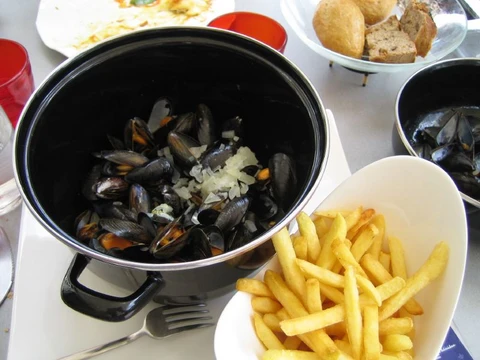
Belgian wine
Belgian wine, revived from medieval roots, now produces mostly white wines.

Michal Osmenda from Brussels, Belgium · CC BY-SA 2.0
Belgian wine is produced in several parts of Belgium, with a history dating back to the 9th century. Though production remained modest—1,400 hectoliters in 2004—it has expanded in recent decades as part of a larger trend of cold-climate winemaking.
- production_2004
- 1,400 hectoliters
- first_appearance
- 9th century
- first_AOC_created
- 1997 (Hageland)
- primary_wine_style
- White wines (90% of production)
- key_white_grape
- Chardonnay
- number_of_AOCs
- 5 (4 in Flanders, 1 in Wallonia)
- number_of_Vin_de_Pays_regions
- 2
Lore & Background
Belgian wine first appeared in the Middle Ages, around the 9th century. The first cultivators were monks, who needed a clean, safe beverage for celebrations. Vineyards were well established in Amay, and the vineyard at Vivegnis was already considered old in the 9th century. The edges of the Meuse River were intensively cultivated for their well-exposed hillsides. By the 14th century, each city had its own vineyard, with place names such as Wijnberg and Wijngaard surviving.
Reader's Guide
Belgian wine, though modest in volume, represents a notable revival of a medieval tradition. Its five AOCs—four in Flanders and one in Wallonia—reflect a structured approach to quality, with authorized grape varieties including Chardonnay, Pinot noir, and Riesling. Around 90 percent of production is white wine, with oaked Chardonnay receiving particular attention from critics. The country's wine competitions are few, but the International Wine Contest of Monde Selection has received patronage from the O.I.V. Belgian wine's significance lies in its demonstration that cool-climate regions can produce distinctive wines, and in its connection to a viticultural heritage that stretches back over a millennium.
Did You Know?
- The first Belgian vineyards were cultivated by monks in the 9th century.
- Belgium has five officially demarcated AOCs, four in Flanders and one in Wallonia.
- Around 90 percent of Belgian wine production is white wine.
- The first Wallonian AOC, Côtes de Sambre et Meuse, was created in 2004.
Wine's Roman Arrival in Belgica
When Caesar's legions took control of northern Gaul in 54 BC, the territory that would become Belgium entered a four-century span under Roman rule. One of the most consequential effects of this conquest was the integration of the region into the empire's vast commercial infrastructure. The Roman road network, built to serve military logistics, simultaneously opened channels for goods to flow from distant provinces into Gallia Belgica. Among the products that arrived along these routes were olive oil and wine, both originating from Mediterranean regions far to the south. This meant that for the first time, the people of Belgica had access to a grape-based beverage that was not locally produced but imported as a trade commodity. The presence of wine in the region was thus fundamentally a product of imperial commerce rather than local viticulture, a distinction that would shape how the drink was perceived and consumed for generations to come.
A Luxury for the Few
Archaeological evidence from sites near Tienen paints a vivid picture of everyday life in first- and second-century Belgica, and wine's place in it was decidedly secondary. The staple of most households was puls, a simple preparation of cereals heated with water or milk and a touch of olive oil, typically accompanied by lentils or beans. When it came to drinking, water held the top spot, followed by milk and beer. Wine, by contrast, occupied a more elevated position in the social hierarchy of the table. It was not consumed straight but rather diluted with water and flavoured with spices, a practice that made it more palatable and perhaps stretched the supply further. Access to wine was closely tied to wealth: the well-off could afford to include meat and wine in their meals with regularity, while the majority of the population rarely experienced either. In this way, wine functioned less as a daily beverage and more as a marker of social standing, a luxury imported from the Mediterranean that set the elite apart from the common folk.
The Medieval Turn Away from Wine
The collapse of the Western Roman Empire brought a profound shift in the culinary habits of the region. The Franks and other Germanic peoples who settled the former territories of Belgica carried with them preferences that ran counter to Roman tradition. Where the Romans had relied on olive oil, the newcomers favoured butter. Where wine had been a recognised part of the drinking culture, ale took its place as the preferred fermented beverage. This was not merely a matter of taste; it reflected a broader cultural reorientation. The Christianisation of the Frankish Kingdom under Clovis I at the end of the fifth century further reshaped the food landscape. Monasteries became centres of brewing and cheese-making, and the Catholic Church's prescription of at least 195 fasting days per year pushed the diet toward bread, fish, and eggs while suppressing meat. In this new order, wine receded further into the background, its Roman associations fading as ale and butter became the defining elements of the emerging Flemish and Brabantine table.
Beer's Shadow Over Wine in Belgian Identity
Outside Belgium, the country's culinary reputation rests almost entirely on a handful of iconic products: chocolate, waffles, fries, and above all, beer. Wine does not feature in this list, and its absence is telling. Within the country itself, local beer is recognised as a characteristic ingredient in traditional dishes, woven into the fabric of regional cooking in a way that wine simply is not. The historical trajectory reinforces this pattern. From the medieval period onward, the brewing traditions of monasteries and the commercial vitality of Flemish and Brabantine cities like Bruges, Antwerp, and Ghent cemented beer's centrality to Belgian food culture. These cities became major European trading hubs, importing spices and exotic fruits from around the world, yet the native fermented drink that defined the local palate remained ale. Wine, once an imported Roman luxury, never reasserted itself as a core element of Belgian identity, leaving it permanently in the shadow of the nation's more celebrated brew.
Gallery

Frequently Asked Questions
What is Belgian wine?
Belgian wine refers to grape-based wines cultivated and bottled within Belgium's borders, spanning both the Flemish and Walloon regions. It is a small but growing element of the country's food-and-drink identity, sitting alongside the more internationally known beers and chocolates.
How far back does Belgian wine's history go?
Vine cultivation in Belgium traces to at least the 9th century, making it one of the older wine traditions in northern Europe. Output stayed modest for centuries before a modern revival took hold in the late 20th and early 21st centuries.
What style of wine does Belgium mainly produce?
Roughly 90 percent of Belgian wine output is white, with Chardonnay serving as the flagship grape. This skew toward lighter, crisp styles reflects the cooler climate that suits white varieties far better than heavy reds.
How much Belgian wine is actually made?
Total production stood at about 1,400 hectoliters in 2004, a figure that shows just how niche the sector remains. Recent decades have seen gradual growth as part of a wider cold-climate winemaking trend across northern Europe.
How is Belgian wine regulated or classified?
Belgium operates five AOC appellations: four in Flanders and one in Wallonia. The first of these, Hageland, was created in 1997 to protect the distinct identity of that particular growing area.
More in Belgian cuisine 1-24
Spotted an error? Know more?
This is a living reference — every entry is fact-audited, and reader corrections feed straight into our audit queue. Suggest an edit · See this site's audit record