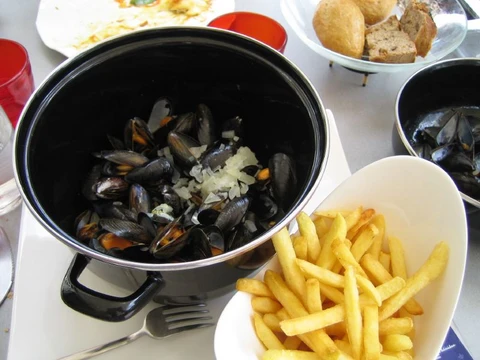
Moules-frites
Belgian national dish of mussels and double-fried fries.

Moules-frites, also known as moules et frites, is a main dish of mussels and French fries originating in Northern France and Belgium. It is considered the national dish of Belgium and is popular in many countries, likely created by combining mussels from the Flemish coast with fried potatoes commonly eaten in winter.
- origin
- Northern France and Belgium
- type
- Main dish
- main_ingredients
- Mussels and French fries
- national_dish_of
- Belgium
- common_variants
- Moules marinière, moules nature, moules à la crème, moules parquées, moules à la bière, moules à l'ail
Lore & Background
Moules-frites likely originated in Belgium, combining cheap mussels from the Flemish coast with fried potatoes eaten when other food was scarce. The dish is available in most restaurants in Belgium and France, depending on season. In 2011, a TNS survey found it was the second-favourite dish in France with 20% of votes, behind magret de canard at 21%.
Reader's Guide
Moules-frites holds significance as the national dish of Belgium and a staple of both Belgian and French cuisine. The mussels are cooked in various ways, such as moules marinière with white wine and shallots, or moules à la bière with beer. The fries are typically made from bintje potatoes and double-fried for a crisp exterior and moist interior. The dish is served with the mussels in their cooking pan and a separate dish for shells, often accompanied by an abbey lager or dry white wine. In Belgium, 25 to 30 tonnes of mussels are consumed annually as moules-frites, many from Zeeland farms in the Netherlands. The dish is central to events like the braderie of Lille, where 500 tons of mussels and 30 tons of fries were consumed in 2009.
Did You Know?
- Moules-frites is the national dish of Belgium.
- In 2011, a TNS survey ranked moules-frites as the second-favourite dish in France with 20% of votes.
- Between 25 and 30 tonnes of mussels are consumed each year in Belgium as moules-frites.
- The fries are typically double-fried to achieve a moist interior and crisp exterior.
More in Belgian cuisine 1-24
Spotted an error? Know more?
This is a living reference — every entry is fact-audited, and reader corrections feed straight into our audit queue. Suggest an edit · See this site's audit record